Space Race
A cooperative-competitive board game where players mine resources across the solar system, trade with rivals, and race to build a spaceship and escape.
Role
Game Designer, 3D Modeller & Visual Designer
Team
4 people
Technologies
Overview
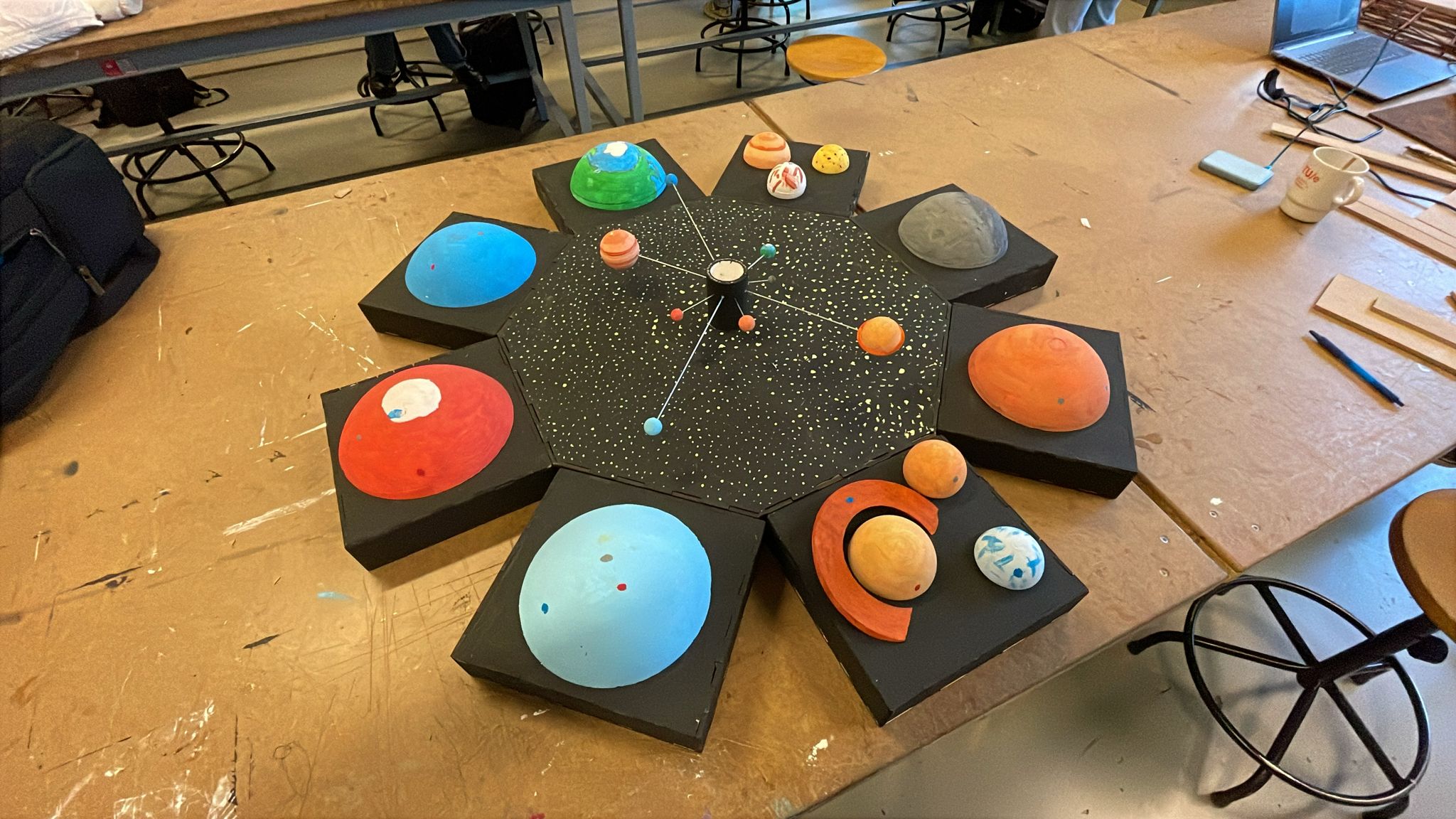
Space Race is a physical board game for 3 to 8 players that uses the solar system as both its setting and its educational backbone. Each player is assigned a planet in the solar system, builds factories to produce water, metal, and fuel, upgrades their base, and eventually unlocks the ability to travel between worlds to trade resources and collect planet-specific special materials. The first player to assemble all four parts of a final spaceship and escape the solar system wins.
The game was designed to make space genuinely compelling to a teenage and student audience by embedding real planetary facts into the gameplay rather than bolting education on top. Planet cards carry true facts about surface composition, moons, and atmospheric conditions. The special material each planet produces is grounded in actual or speculated planetary chemistry: diamonds on Mercury, silicon oxide on Uranus, liquid hydrogen on Jupiter. A non-collocated player can join remotely as a space pirate, traveling between planets to trade without owning a world.
The project ran in semester A of 2025-2026 at TU/e as part of the PB110 CBL program, with teammates Aniek Kuijpers, Duco van Dijk, and Leonor Silva Sousa. Coaches: Tom Raijmakers and Kevin Pfeil.
My Role
My contributions spanned game design, 3D modelling, and visual production:
- Sketching the initial center board layout and spatial relationship between the octagonal frame and the planetary modules
- Creating the final 3D digital model of the full board assembly, showing all eight planet modules attached to the octagonal center
- Designing and 3D modelling the resource tokens (water, metal, fuel, spaceship parts) in a way that gave us design freedom beyond painted beads
- Contributing to the special materials table and the rulebook's materials overview section alongside Aniek
- Participating in all brainstorming and ideation sessions
- Contributing to box design sketches alongside Duco
Research and User Understanding
Ideation
The brief was to create an educational hybrid digital-physical game. We started with mind maps on both Miro and paper, generating a wide field of themes before settling on space. Within that theme, we explored exploration games, simulation games, and competitive formats before converging on something cooperative-competitive: players share the solar system but each pursues their own end goal, which naturally forces interaction and trade.
An early concern was the hybrid digital requirement. We moved through several approaches to the non-collocated player before landing on the space pirate role, which lets a remote player join through a digital interface and travel between planets to trade, without the overhead of a full parallel digital game.
Play tests and feedback
We ran a self-directed play test first to calibrate card balance, resource amounts, upgrade costs, and the feel of the travel system. This gave us a baseline before showing the game to others.
Peer feedback from the first showcase identified two clear gaps: the game felt like it could be played solo rather than truly with others, and the educational content was too light. At that point we only had question cards. Both points sent us back to redesign.
A structured user test with a group of ten participants during a coaching session gave us more detailed findings. The start of the game moved too slowly because the available actions were limited in early rounds. The minigame cards felt out of place. The educational content was described as indirect rather than explicit. Rules were considered clear but numerous.
We responded to each point: the minigames were made space-themed to fit the context better, star card numbers were rebalanced and re-themed, and we added a planet information card for every planet in the solar system, available to all players throughout the game.
Persona
Our persona was Bart Janssen, an 18-year-old student who loves space and board games and has a long-distance friend he wants to play with. His pain points were the absence of collaborative space games and the lack of titles that teach real facts. His goals were to socialise while learning and to have a reason to play with someone not in the room. The non-collocated space pirate role and the planet info cards were both directly shaped by his profile.
Prototyping
First iteration: The board was a flat rectangle with drawn planetary icons, question cards that awarded resources on correct answers, and a travel card pulled from the same deck as other cards. The play test showed the travel card distribution was unbalanced, the question cards felt disconnected, and the flat rectangle was visually unappealing and did not communicate the solar system spatially.
Second iteration: We moved to an octagonal board shape, matching the eight-planet count, with detachable planet modules along the perimeter. Planets were initially flat illustrated tiles on slanted boards, which looked better but made factories fall off during play. Cards were separated into distinct types: star cards (space events with proportionate rewards or penalties, buyable), game cards (a minigame at the start of each round), planet cards (facts and surface image), and travel cards (earned through upgrading the starter base to level 3). Resource tokens moved from post-it notes to painted wooden beads, which were the right size but rolled off tables.
Final prototype: The planet modules became flat-topped foam dioramas with 3D sculpted planet surfaces protruding from the board, making each one visually distinct and tactile. Factories attach via a nub-and-hole system so they sit on the curved planet surface without sliding. The resource tokens became 3D-printed custom shapes, one distinct form per resource type, designed to be stackable and non-rollable. The central octagonal frame doubles as a storage box: the planet modules fold inward to form the sides when not in play. A static 3D solar system model sits at the center of the octagon, indicating the orbital position for each module and adding a structural spine to the whole assembly. A planned motorized orbital mechanism was dropped in favour of this static approach after assessing the time and complexity cost.
Outcome
The final game was presented at the CBL showcase. Players could pick up the rules and begin playing without extended explanation. The board drew attention before the game even started, which was one of our explicit aesthetic goals.
Key learnings
- Educational content embedded in gameplay mechanics lands far better than content bolted on as a separate layer: planet facts on cards players physically hold throughout the game were absorbed more naturally than question-and-answer rounds
- Physical form matters for tokens: painted beads were the right visual scale but wrong physics; designing custom 3D-printed shapes solved usability and aesthetics at the same time
- The non-collocated player role needs a reason to exist beyond just mirroring the in-person experience; giving the space pirate a distinct identity and different win condition made remote participation feel intentional rather than compensatory
- Abandoning the motorized orbital mechanism was the right call: a simpler static model delivered the same visual information without the complexity, and left the door open for a future upgrade
Gallery