Melodoodle
A physical–digital musical game where players draw chalk patterns on the ground and step on colors to create music, combining movement, creativity, and sound.
Role
Electronics Designer & Firmware Developer
Team
5 people
Technologies
Overview
Melodoodle is a physical–digital educational game designed for children, developed as part of the DPB110 Challenge-Based Learning program at Eindhoven University of Technology (2024–2025, Semester A). The design brief was to create a physical–digital hybrid educational game; our team identified a gap in the market for music education that is engaging, active, and social rather than screen-bound and passive.
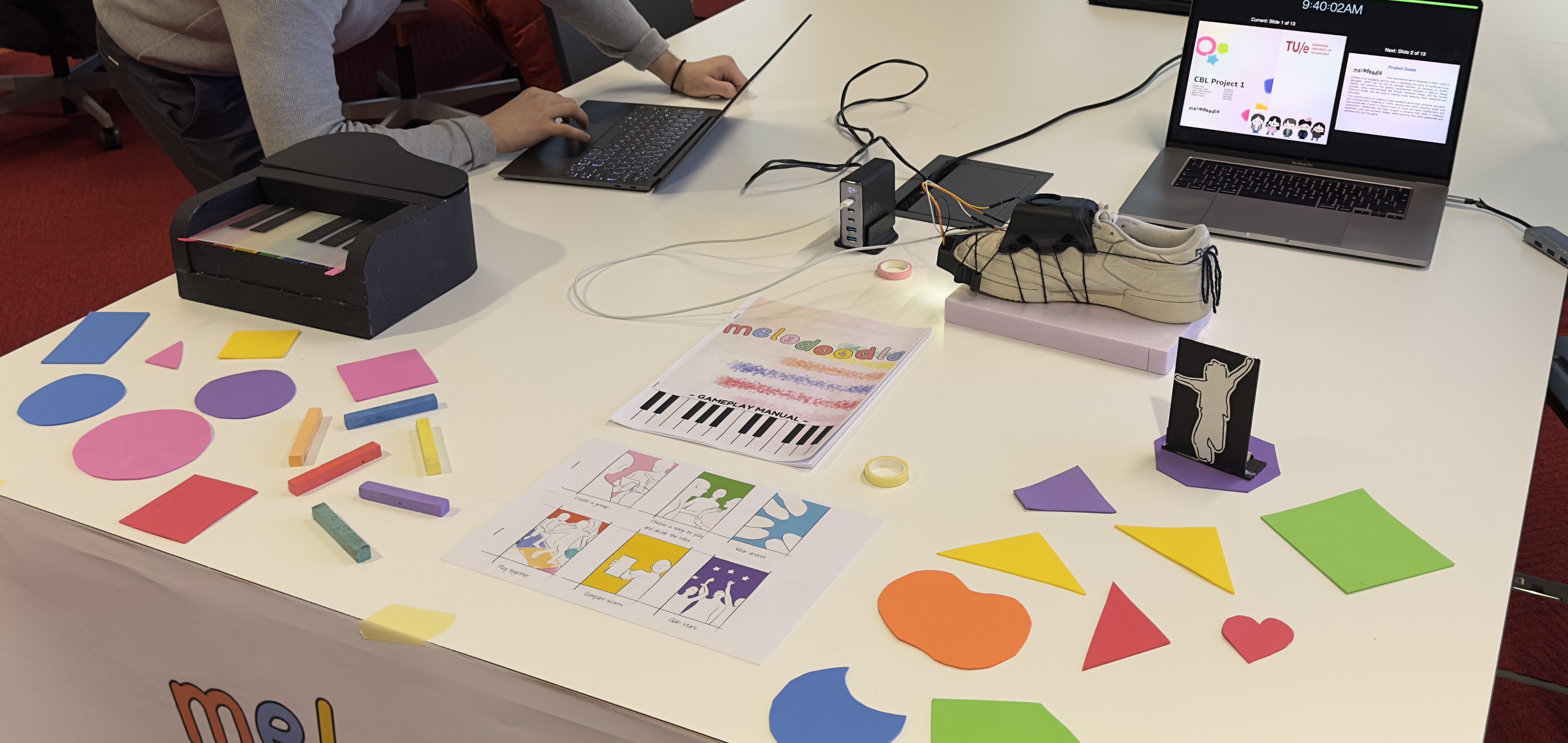
The concept draws on the childhood game of hopscotch. Players use colored chalk to draw their own patterns on any flat surface, where each color maps to a musical note. A wearable device strapped to the foot reads the chalk color underfoot using a color sensor and plays the corresponding note in real time, while a companion phone app handles song selection, scoring, and multiplayer coordination. The result is a game where drawing, jumping, and music-making are inseparable.
The project ran from September 2024 to February 2025 with a team of five: Ballaj Shah, Francesca Lasic, Leen Fathelrahman, Robert Braun, and Robert Lazar.
My Role
I was responsible for the full electronics stack, from component selection through to firmware running on the final PCB. This included:
- Selecting and integrating the VEML6040 (ambient color) and VCNL4040 (proximity) sensors as a consolidated solution in place of separate RGB and proximity modules considered earlier
- Designing a custom two-layer PCB around the ESP32-S3 module, with filtered sensor input, optimized antenna placement, onboard LiPo charging with thermal management, USB-C protection circuitry, and EMI reduction via ferrite beads
- Choosing a compact 1.28" round GC9A01 LCD over a larger display to keep the form factor wearable and reduce power draw
- Writing the C/C++ firmware for sensor reading, BLE data transmission, LED feedback, and audio output
- Coordinating the hardware–software interface with the team's interaction designer and app developer
I also built the early breadboard demonstrator used in the Best Idea Bananza showcase, which was the first working proof of the color-sensing audio concept and won that activity.
Research & Ideation
Design process
The team followed a Double Diamond process, drawing on Human-Centered Design principles from Tim Brown's Change by Design and the Interaction Design textbook by Rogers, Sharp & Preece.
We generated around 51 initial concepts in open divergent sessions before converging on a shortlist of 20. Rejected concepts included ArtiQuest (QR codes on public artworks, too screen-focused and solitary) and Senso Chess (sensor-embedded chess pieces, too static and not physically energetic enough). The hopscotch-inspired music game resonated most strongly, both for its physical engagement and for preserving the freeform "doodling" spirit we wanted.
User research
We conducted structured interviews with potential users, using simple and focused questions based on best practices from Rogers, Sharp & Preece. Key questions covered gaming habits, attitudes toward movement-based play, the value of co-located multiplayer, and comfort with a wearable sensor. Findings confirmed that:
- Mixing physical movement with music creation was broadly appealing, aligning with Jensen (2000) on body-based learning and Moreno et al. (2011) on early music exposure.
- Cooperative play was preferred over competitive; participants felt group modes produced better learning outcomes (Johnson & Johnson, 1989).
- The device needed to be lightweight, secure, and require no lengthy setup.
We also consulted research on gamification in music education (Reinhardt, 2019) and digital game-based music learning (Tobias, 2012), which gave confidence that marrying movement, music, and digital feedback was an established pedagogical approach, not merely a novelty.
Personas
Three personas shaped design decisions throughout:
- Daniel (28, elementary school teacher): needed easy setup, curriculum alignment, durability, and a feedback system students could follow independently.
- Angela (32, parent): wanted a safe outdoor-friendly product with no long instructions, physical activity, and social play.
- Damin (8, student): wanted creative freedom, instant rewards, and a game easy enough to jump into without feeling left out.
Technical Design & Realization
Game concept and modes
Rather than using pressure-sensitive pads (which would have constrained creative layouts), we chose a wearable foot device with a color sensor, letting players draw any shape in any size as long as it has color. This preserved the open-ended "doodling" aspect central to the concept.
The final game supports four modes:
- Single Player: practice solo, improving accuracy and timing against a chosen song.
- Same Setting Co-Op: players in the same physical space team up to perform a song together.
- Different Setting Challenge: players in separate locations compete on a shared leaderboard.
- Composer: create, edit, and save original songs for future play.
Electronics
Three hardware iterations:
- Breadboard prototype: validated the color sensor and BLE pipeline; exposed noise issues under ambient light that were addressed in hardware rather than software.
- Perfboard + 3D printed enclosure: tested form factor with real users; identified that grip diameter, button placement, and foot attachment method were critical.
- Custom PCB (final): two-layer board integrating the ESP32-S3, VEML6040, VCNL4040, GC9A01 LCD, audio amplifier with EMI filtering, and onboard LiPo charging. The elastic band attachment from iteration two was replaced with a shoelace mount for a more secure fit, and the underside was molded to match shoe geometry.
Phone App
The companion app was built using bolt.new, an AI-assisted web app builder, allowing the team to produce a high-fidelity working interface without deep web development expertise. The app handles instrument selection, song library browsing, real-time score feedback, and multiplayer session management. The UI reflects the colorful aesthetic of the game and was designed to be immediately legible to children.
Box Design
The game packaging takes the shape of a grand piano, reinforcing the musical theme and designed to excite children before they even open it. An initial card-and-hot-glue prototype proved the concept; a refined second iteration used higher-quality materials with dedicated compartments for the wearable device, chalk, the game manual, and a game modes booklet.
Outcome
The final prototype was presented at the TU/e Design United showcase. Both players understood how to interact with it immediately. No explanation needed. The team received commendation for hardware quality and responsiveness.
Key learnings
- Fixing sensor noise at the hardware level (filtered inputs, component placement) is far cheaper than compensating in firmware
- Rapid 3D-printed enclosure iteration saved significant time over machined alternatives and produced direct user feedback on ergonomics
- Writing firmware in modular, testable functions made integrating teammates' code straightforward
- Combining color sensor and proximity detection in a single consolidated component (VEML6040 + VCNL4040) simplified the PCB layout and improved reliability over separate modules
Gallery