PeacePod
A speculative private mobility concept that balances pandemic-era safety with the need for social connection through optional shared pod routes.
Role
Physical model creation, Physical UI/UX creation, Material selection and mathematics of it, Ideation.
Team
5 people
Technologies
Overview
PeacePod is a speculative vehicle concept designed for a future in which pandemics are frequent, severe, and socially disruptive. In this projected world, set in the mid-to-late 2060s, everyday mobility becomes a negotiation between personal safety and social connection. Sharing a vehicle no longer feels neutral; it carries a perceived health risk. At the same time, permanent isolation becomes psychologically and socially unsustainable.
The project responds to that tension by proposing a compact, private, automated-capable pod that can be used as an individual vehicle or joined into a shared route system. In shared mode, pods connect to one another through a flexible rail-like system, allowing passengers to communicate and socialise while retaining the sense of a protected personal environment.
The exterior is designed to read as protective, clean, and reassuring: a compact teardrop form with smooth curves, a matte metallic finish, hands-free door operation, and side light strips for external human-machine interaction. The interior is warmer and calmer, using cream tones, curved surfaces, a wrap-around dashboard, and a swivel chair that supports entry and everyday use. The dashboard becomes the main point of interaction, balancing driving information, environmental awareness, climate control, and social features.
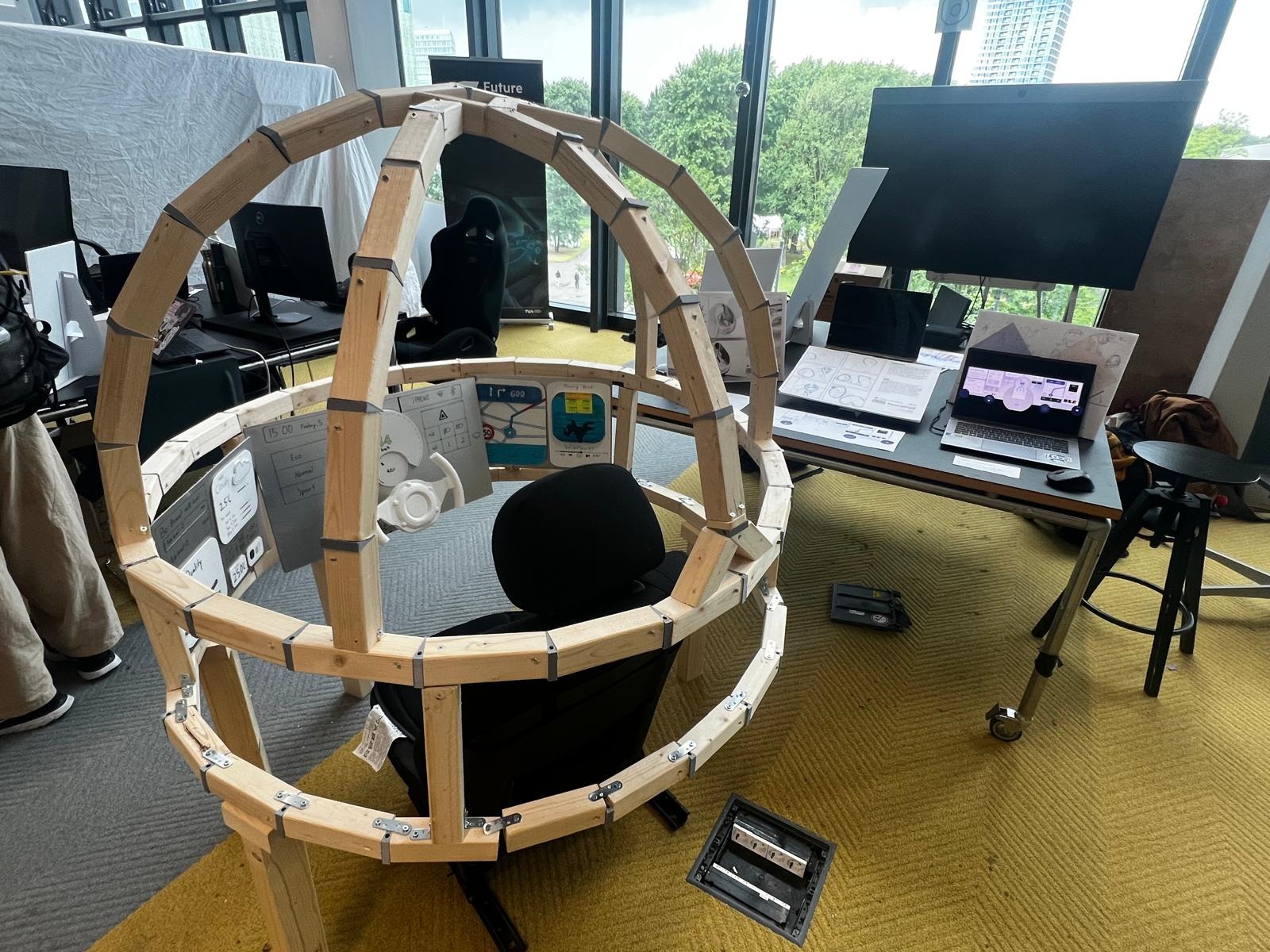
The project was developed as part of the DPB240 Challenge-Based Learning programme at Eindhoven University of Technology, Semester B, in the Future Mobility squad under the guidance of Pavlo Bazilinskyy. The team included Arya Gupta, Tan Ler Shan, Esther Tonkinwise, Yu-Jie Chen, and Robert Lazar. The final package included a 1:1 scale physical model, an interactive dashboard prototype, renders, animation, a storyboard, and a Business Model Canvas positioning PeacePod as a potential Business-to-Government mobility system.
My Role
Within the five-person team, I contributed to the conceptual, research, prototyping, build, and documentation phases of the project. My focus was on helping the speculative concept become more tangible through early prototyping, 3D modelling, user interviews, physical build support, and practical material management.
My main contributions were:
- Contributed to scenario ideation and brainstorming, helping shape the pandemic-ridden future and the private/shared mobility direction.
- Developed low-fidelity prototypes to explore early concept options and make design decisions easier to discuss.
- Contributed 3D modelling of the PeacePod concept, supporting form exploration, proportion development, and project communication.
- Conducted user interviews and contributed participant feedback to the team’s iterative design process.
- Contributed to the physical prototype, including material acquisition, budget allocation, and build support.
- Contributed to the group report, helping document the project process, research findings, prototyping decisions, and final reflections.
Rather than owning one subsystem, my role was to connect the team’s speculative direction with tangible prototype evidence, user feedback, and practical build constraints.
Research
Speculative framing and the problem of shared mobility
The project began with signal scanning rather than a fixed product brief. The team looked for societal trends that could plausibly intensify into a future design challenge. Post-COVID behaviour, increasing health anxiety, the growth of private automated mobility, and the psychological effects of isolation became the main signals.
I contributed to this early phase by participating in scenario ideation and brainstorming. I helped explore how a pandemic-heavy future could change the way people think about private versus shared transport, and how that tension could give the vehicle a believable purpose.
The core design question emerged from a contradiction: people may want the privacy and perceived safety of a personal vehicle, but they also need social connection and efficient urban mobility. PeacePod was therefore framed not as a traditional public transport vehicle, and not simply as a private car, but as a hybrid form of mobility that can operate individually or as part of a shared route.
This speculative framing was important because it allowed the team to avoid designing an idealised future. Instead of asking, “How might we make transport more sustainable?” the project asked, “How might be a future where pandemics are common, and what would mobility need to look like there?” That shift made the design more honest, more urgent, and more open to scenario-driven decisions.
The Personal Rapid Transport gap
Research into existing Personal Rapid Transport systems helped identify a market and design gap. Many PRT concepts focus on public, multi-passenger, or fixed-route systems. Others, such as robotaxis and autonomous shuttles, offer point-to-point private movement but do not strongly address social connection or shared mobility.
By mapping these systems, the team identified an under-explored space: a vehicle that is private by default, but can become part of a shared route when needed. This idea became the conceptual basis of PeacePod.
My role in this stage was mainly to help test and interpret these directions through ideation, low-fidelity prototyping, and 3D modelling discussions. This helped the team move from abstract future scenarios toward more concrete vehicle concepts.
Pandemic mindset, safety, and calm
A key research insight was that safety in a pandemic context is not only physical. It is also emotional. The design needed to reduce perceived contamination risk, but it also needed to avoid feeling clinical, anxious, or prison-like. The team described the desired tonality as “medical yet calm and inviting.”
This insight shaped the project’s material and visual direction. Early explorations that leaned too strongly into sterile metal and clinical surfaces were reconsidered. Instead, the final design split its language: the exterior communicates protection, cleanliness, and resilience, while the interior provides warmth, comfort, and calm.
I contributed to turning these ideas into practical design questions, especially around how the pod should feel physically, how users should interact with it, and what kind of reassurance the prototype should communicate.
Interview insights
The project used both survey and interview research to test assumptions about the concept. I conducted interviews with participants and contributed their feedback to the team’s iterative design process.
The interviews were useful because they revealed tensions that were not always obvious from abstract sketches or renders. Participants wanted awareness of external conditions, including environmental and health-related information, but they did not want that information to dominate their attention while driving. This helped the team understand that the dashboard and interaction design needed to inform without alarming.
My interview contribution helped make the design more responsive to real user feelings, especially around safety, privacy, trust, and comfort.
Prototyping
The project followed a circular, iterative process rather than a strictly linear one. Different prototypes tested different parts of the concept: scenario credibility, form language, user interaction, physical scale, and practical build feasibility.
My prototyping contribution focused on early low-fidelity exploration, 3D modelling, user interviews, physical prototype support, and material/budget management.
1. Initial ideation and scenario correction
I contributed to early brainstorming and low-fidelity prototyping. The team explored several vehicle concepts, including a “peas in a pod” system, a modular caravan, and a multi-terrain vehicle. The “peas in a pod” idea was particularly useful because it suggested that individual pods could connect into a shared mobility system while remaining separate physical cabins.
However, the team realised that these concepts needed a stronger future context to feel convincing. Without a clear societal reason for the vehicle to exist, the ideas remained visually interesting but strategically weak. The project therefore circled back to signal scanning and scenario definition, ultimately fixing the context as a pandemic-ridden future.
I contributed to this reflection process by helping test early ideas through low-fidelity prototypes and exploring how the “peas in a pod” concept could be given a clearer purpose.
2. 3D modelling
I contributed 3D modelling of the PeacePod concept. This helped the team explore the pod’s form, proportions, and spatial logic, and gave a more concrete basis for discussing the vehicle as a protective personal environment.
The 3D modelling helped connect the early sketches and ideation work to the later prototype development. It also made it easier for the team to evaluate the teardrop shape, the single-person cockpit, and the general character of the vehicle before moving into higher-fidelity work.
3. User testing and dashboard iteration
The team developed a dashboard prototype to test how information should be presented in a pandemic-sensitive context. The dashboard needed to balance driving information, environmental data, health-related information, and social features without overwhelming the user.
I conducted interviews with participants and contributed their feedback to the team’s evaluation of the dashboard and interaction concepts. My role was to facilitate the interview sessions, capture participant responses, and bring those observations back to the team so the design could be improved.
This helped the team identify an important design tension: users wanted to feel informed about the outside world, but they did not want the interface to feel alarming or distracting. As a result, the project moved health-risk information away from a dominant position and made it easier to control or hide.
4. Physical prototype and materials
I contributed to the physical prototype, including material acquisition and budget allocation. This involved sourcing the materials needed for the build, keeping costs within the project budget, and supporting practical decisions as the prototype was developed.
The physical model was important because it allowed users to experience the scale, proportion, and seating position of the single-person pod. It also revealed limitations that were less visible in digital models, such as the restricted peripheral vision caused by the front window position.
My material and budget work helped make the physical prototype achievable within the project constraints. This was an important part of turning a speculative concept into something users could physically enter and test.
5. Documentation and reporting
I contributed to the group report, helping document the project’s research, prototyping process, and reflections. This included explaining how early ideas evolved into the final PeacePod concept, how user feedback influenced the design, and how practical build constraints shaped the physical prototype.
Documentation was important because it helped make the project’s iterative process visible. It also allowed the team to connect the speculative scenario, the design decisions, the user research, and the final prototype into one coherent story.
Outcome
PeacePod was presented at Demo Day as a complete speculative mobility package. Visitors could sit inside the 1:1 model, interact with the dashboard prototype, view the storyboard and animation, and engage with the scenario. The project demonstrated a vehicle concept that felt both personal and public, protective and social, technological and emotionally responsive.
My contribution supported the final package by helping shape the concept in early ideation, testing assumptions through interviews, contributing 3D modelling, and supporting the physical prototype build and material management.
The strongest result of the project was not a single artefact, but the coherence between scenario, exterior, interior, dashboard, and physical model. The pandemic-ridden future gave the design a clear emotional logic: the pod protects, but does not isolate. It shares, but does not expose. It informs, but does not alarm.
Feedback from Demo Day and internal reflection identified several important limitations:
- The single-person cockpit limits family travel and group socialising.
- The current shared route system effectively supports one-to-one pod connections, not branching multi-person groups.
- The teardrop form limits peripheral vision, especially in dense or cycling-heavy urban environments.
- Some dashboard features still do not fully balance information provision with cognitive load.
- Engineering feasibility remains unresolved, particularly around two-wheel balancing, route joining, and the safety implications of automated driving.
These limitations are not framed as failures. They are part of the speculative design process. A project like PeacePod is not meant to be a complete engineering proposal, but it does need to remain credible. The limitations point to the next steps: sensor integration, infrastructure redesign, broader user testing, and more rigorous systems thinking.
Key Learnings
- Early low-fidelity prototyping is useful for making speculative concepts more discussable before committing to high-fidelity work.
- 3D modelling helps communicate a concept visually, but physical prototyping reveals practical constraints such as scale, materials, budget, joints, and usability.
- User interviews can reveal emotional responses that are not obvious from renders or abstract sketches.
- In health-sensitive design, safety communication needs to be reassuring rather than alarming.
- Managing materials and budget is part of design thinking; practical constraints shape what can be built and tested.
- Documentation and reflection help connect the project’s research, prototyping, and final outcome into a coherent design story.
Gallery